
How Seiko Automatic Movements Work (Beginner’s Guide 2026
Automatic watches have been fascinating watch enthusiasts for generations. Unlike quartz watches, which require a battery, an automatic watch winds itself using the natural motion of your wrist.
Seiko is one of the leading makers of automatic watch movements in the world, producing millions of reliable mechanical calibers annually. If you’re looking to buy your first Seiko 5, or you’re interested in a Prospex diver, knowing how Seiko automatic movements work will help you choose the right watch.
In this article, we’ll show you how Seiko automatic movements work, their key components, benefits, care requirements and why they are a favorite among collectors and regular wearers alike.
Best models? Find them here. Check out our Best Seiko Watches Under $500 USA guide for top picks.
What Is an Automatic Movement?
An automated movement (sometimes termed a self-winding movement) is a mechanical watch movement that uses the motion of your wrist to create power.
It stores energy in a tightly wound mainspring, not in a battery. As you go about your day, the inner rotor turns and automatically winds the mainspring.
That means you’ll never have to change the battery as long as the watch gets normal wear.
How Does a Seiko Automatic Movement Work?
Seiko has been a pioneer in the development of automatic watch movements. Since the early 20th century, Seiko has been at the forefront of innovation in this field. One of the company’s first breakthroughs was the creation of the world’s first self-winding watch movement, which was introduced in 1924. The movement was dubbed the ‘perpetual’ movement because it was able to wind itself with the natural motion of the wearer’s arm. This invention was the beginning of a long line of ground-breaking automatic watch movements produced by Seiko. The company has consistently pushed the boundaries of what is possible with automatic watch technology, producing movements that are both accurate and reliable. Seiko’s dedication to innovation and excellence has made it one of the most respected names in the watch industry.
The process is surprisingly simple, despite the fact that the movement contains dozens or even hundreds of tiny parts.
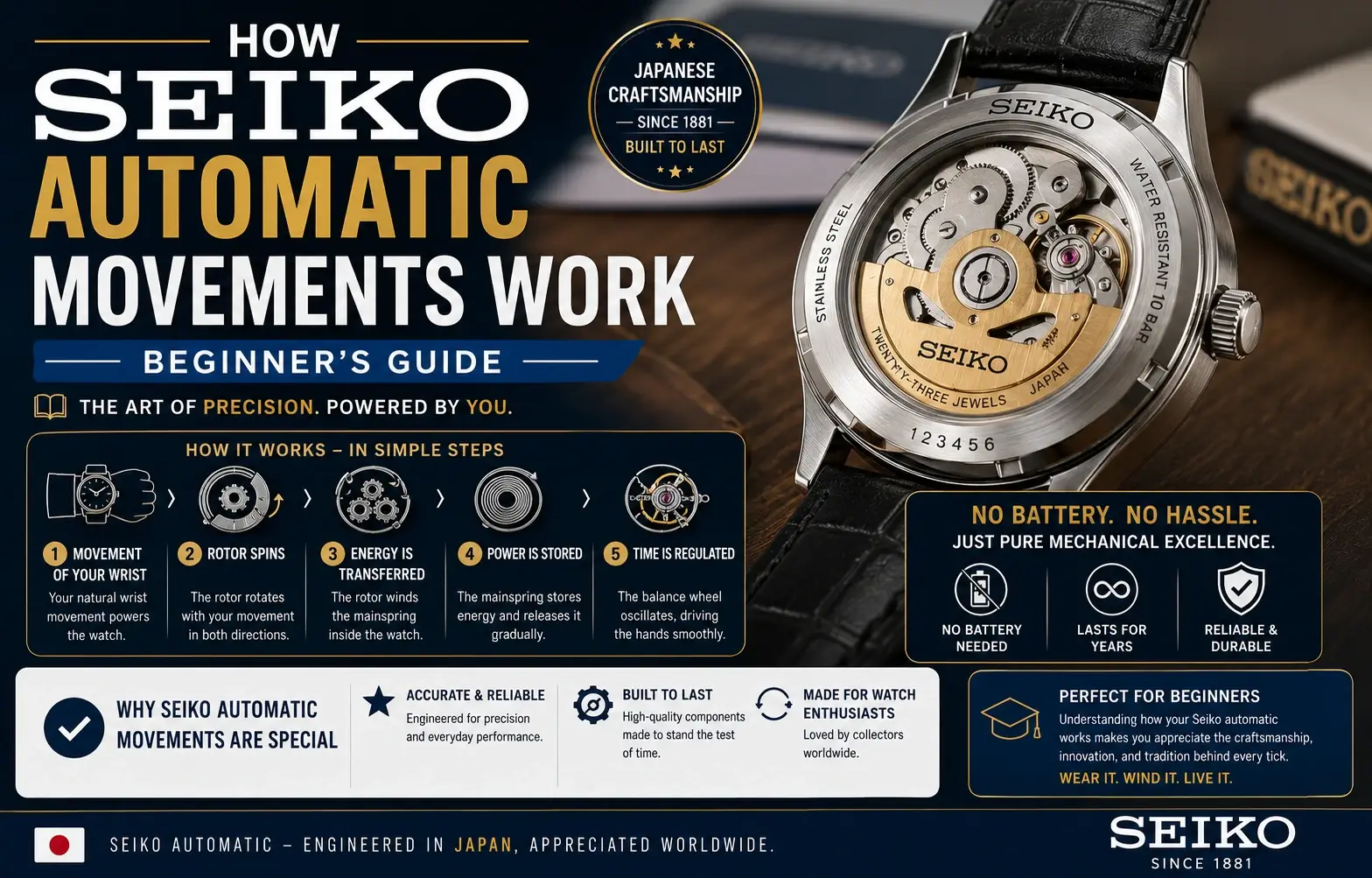
1. Rotate your wrist
With every movement of your wrist while walking, working or driving, the watch undergoes minor movements.
These natural movements are enough to run the watch.
Step 2: The Rotor Spins
Every Seiko automatic watch contains a rotor, a semi-circular weight that spins freely.
Depending on the design of the movement, the rotor will turn in both directions as you rotate your wrist due to gravity.
An automatic winding system revolves around the rotor.
Step 3: Transfer of Energy
A spinning rotor drives a series of gears that slowly wind the mainspring.
It happens all the time while you wear the watch.
Even tiny motions of the wrist during the day keep power up.
Step 4: The Mainspring Stores Energy
The mainspring is a long coiled strip of metal located within a barrel.
It gets tighter and stores mechanical energy.
It’s like winding up an old fashioned toy, very slow.
When it is fully wrapped, it is powerful enough to keep the watch operating for many hours after you take it off.
Step 5: Gear Train Powered by Energy
The mainspring releases its energy slowly through a series of precision gears called the gear train.
These gears are used to power the hands on the dial.
Their carefully calculated gear ratios allow:
- Second hand
- Minute hand
- Hour hand
to move at their proper speeds.
Step 6: The Escapement Regulates the Power
If the mainspring discharged all of its energy at once, the watch would stop nearly immediately.
Instead Seiko utilizes an escapement to control the rate of energy release.
The escapement delivers modest quantities of power to the movement at a consistent rate.
This provides the well-known ticking sound.
Step 7. Balance Wheel Keeps Time.
The balancing wheel swings forth and back numerous times a second.
It swings like a clock’s pendulum.
It, along with the escapement, determines the accuracy of the watch.
The balancing wheel was essential for the watch to keep time.
Main Parts of a Seiko Automatic Movement
All Seiko automatic movements comprise several essential parts.
Rotor
Gather energy from wrist movement.
Main Spring
Stores energy in mechanical form
Gear Transmission
Transfers energy into the hands .
Escapements.
Discharges energy in controlled intervals.
Balancewheel
Keeps track of time.
Jewels
Synthetic ruby bearings reduced friction between moving components.
Most of Seiko’s automatic movements are either 21 jewels or 24 jewels, depending on the caliber.
Popular Seiko Automatic Movements
Seiko has made numerous good automatic calibers over the years.
Some of the more popular ones are:
7S26A
- Classic Seiko 5 movement.
- Very reliable
- No hand rolling.
- No second hacks.
4R36
One of Seiko’s most popular modern calibers.
Features:
- Manual winding
- Taking seconds
- Day and Date Display
- Power reserve approx. 41 hour
6R35
An automatic movement of the highest grade used in several of Seiko’s better models.
Features:
- Extended power reserve (approx. 70 hours)
- Better finishing
- Greater precision
How Long Does a Seiko Automatic Watch Last?
This depends on the movement.
Typical power reserves include:
| Movement | Power Reserve |
| 7S26 | Around 40 hours |
| 4R36 | Around 41 hours |
| 6R35 | Around 70 hours |
If you don’t wind the watch after its power reserve, it will stop until it is wound again.
Can You Manually Wind a Seiko Automatic?
A lot of contemporary Seiko movements are manual winds
.Just turn the crown clockwise while it is in the normal position.
Older movements like the 7S26 cannot be wound manually and rely only on wrist movement.
Always check your model’s specifications before attempting to wind it by hand.
Do You Need To Wear It Daily?
Not necessarily.
If you wear the watch every second day or so it will generally keep running.
If it’s left unused longer than its power reserve, it will cease.
You can reset it through:
- Wearing it for a while
- Hand-wound (if supported)
- Swinging the watch a few times gently (no wild shaking)
The benefits of Seiko Automatic Watches
No Battery Needed
Automatic watches don’t need to change the battery often.
Traditional Handcrafting
The precise architecture of a mechanical movement is appreciated by many consumers.
Long-term service
Seiko automatic watches, if properly maintained, can endure for decades.
Smooth Sweeping Second Hand
Unlike quartz watches, the seconds hand of automatic movements moves smoothly and flows.
Good Value
Seiko has some of the most inexpensive automatic timepieces out there.
Disadvantages
Automatic watches have some trade offs as well.
- Not as accurate as quartz
- Servicing required every few years
- Can cease if not worn often
- Thicker than quartz watches usually
For many enthusiasts, these are acceptable compromises for mechanical craftsmanship.
Automatic vs Quartz
| Feature | Automatic | Quartz |
| Power Source | Wrist movement | Battery |
| Accuracy | Very good | Excellent |
| Maintenance | Periodic servicing | Battery replacement |
| Second Hand | Smooth sweep | One-second tick |
| Lifespan | Decades with care | Decades with care |
Both are good, it just depends on what you like.
Seiko Automatic Watch Maintenance Tips
To keep your watch in good working order:
- Wear it a lot.
- Keep clear from powerful magnets.
- Avoid serious effects.
- Have it routinely serviced by a skilled expert.
- Wipe the case and bracelet with a gentle cloth.
How to properly care for the movement will lengthen its life.
See Also: Seiko Watch Care Guide
Who Should Buy a Seiko Automatic Watch?
Automatic Seiko watches are great for:
- First time buyers of mechanical watches
- Watch lovers
- Collectors.
- Business people
- Anyone who enjoys traditional craftsmanship
If you like the notion of a watch powered by your own motion, an automatic Seiko is a great choice.
Final Verdict
Seiko automatic movements combine classic mechanical engineering with decades of proven durability. Instead of a battery, they run on the power of your wrist and provide an ownership experience that many watch lovers find rewarding.
Choose an entry-level Seiko 5 with a sturdy 4R36 movement or a higher-end model with the 6R35 caliber and you’re getting a timepiece built on more than a century of watchmaking knowledge.
Seiko automatic models still offer some of the greatest value in the mechanical watch world, although the $500 mark is a threshold for many consumers.
Frequently Asked Questions (FAQs)
How does a Seiko automatic watch work?
It has a mainspring that is wound by a rotor that spins with wrist movement . The mainspring stores energy to power the watch .
Do Seiko automatic watches need batteries?
No, automatic Seiko timepieces are powered by mechanical energy created by the movement of your wrist.
How long do Seiko automatic watches last?
A Seiko automatic watch that is well maintained and serviced can survive for decades.
Can I manually wind my Seiko automatic watch?
Hand-wound are a lot of modern Seiko automatic movements, like the 4R36 and the 6R35. Older movements like the 7S26 do not.
Are Seiko automatic watches accurate?
Yes they are good mechanical accuracy but quartz watches are generally more accurate.