
History of Seiko Watches: From a Small Tokyo Shop to a Global Watchmaking Icon (2026)
Today Seiko is one of the world’s most respected watch brands. Said to be the most trusted name in watch making, Seiko has gained the trust of millions of watch fans, professionals and collectors worldwide.
But Seiko didn’t become an international icon overnight. The story started more than 140 years ago at a tiny watch and jewelry business in Tokyo, Japan. Since then the company has revolutionized the face of the watch industry with ground-breaking technologies including the world’s first quartz wristwatch and the innovative Spring Drive movement.
In this article, we will discuss the history of Seiko, their important achievements, and why they are still one of the top watch brands for purchasers in the USA today.
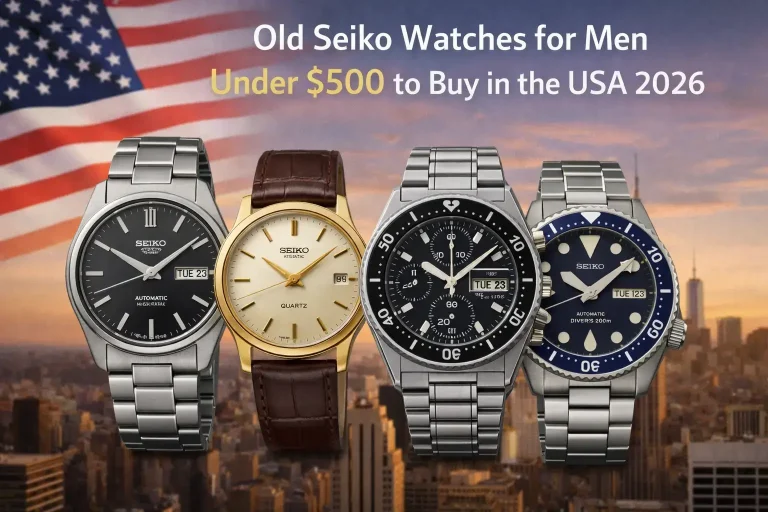
Looking for the greatest Seikos? Best Seiko Watches Under $500 in USA – Top Recommendations. Check out our guide.
The Start: 1881
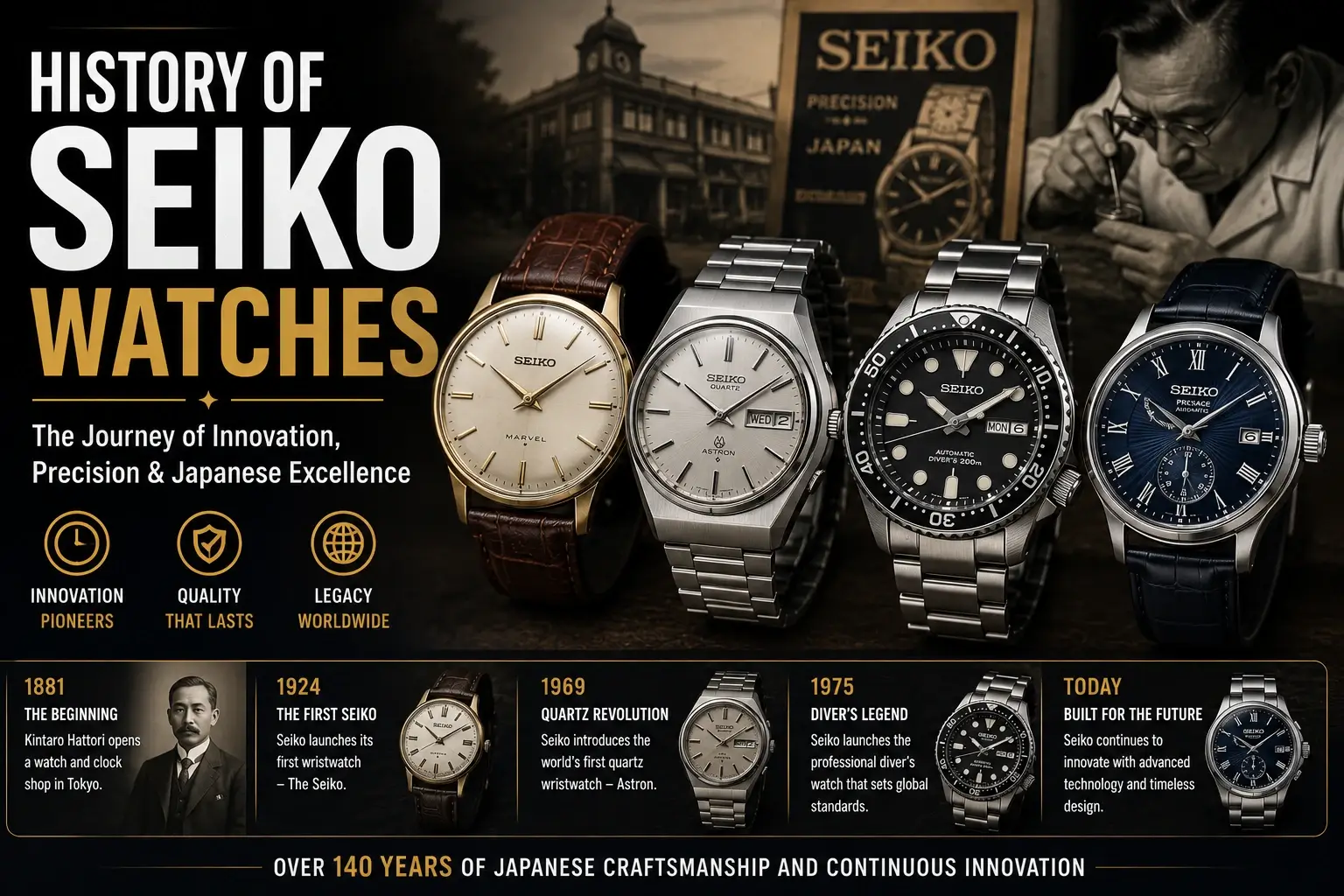
The genesis of Seiko began in 1881 when a young entrepreneur, Kintaro Hattori, opened a tiny business selling and repairing watches and clocks in Tokyo, Japan.
Hattori believed that Japan could produce top-level watches of its own at a time when imported watches were king. His drive to quality and innovation established the groundwork for what would become one of the most influential watch brands in history.
His philosophy was simple:
“Always one step ahead of the rest.
That mentality still drives Seiko today.
1892: The Birth of Seikosha
In 1892, Hattori opened a factory, which he dubbed Seikosha, meaning “House of Exquisite Workmanship.”
Seikosha originally produced only clocks. As its competence evolved, the business added pocket watches and, later, wristwatches to its repertoire.
It was the first stride in Seiko’s development as a legitimate watch maker and not only a merchant.
1913: First Wrist Watch in Japan
It was in 1913 that Seiko scored a major milestone with the launch of the Laurel, the first wristwatch in Japan.
Pocket watches were still more common than wristwatches at the time, a fact that made the Laurel a daring innovation. Production was limited, but it showed Seiko’s ambition to lead the Japanese watch industry.
Laurel laid the path for decades of technological innovation and positioned Seiko as a pioneer in wristwatch design.
1924: The Birth of the Seiko Name
The watches were marketed under the name of Seikosha until the early 1920s.
Seiko launched the first timepiece bearing the Seiko name in 1924 and created the brand identity known throughout the world today.
The name Seiko means “precision,” “success,” or “exquisite,” and is indicative of the company’s commitment to craftsmanship and accuracy.
Post War Growth and Innovation
After World War II Seiko concentrated on recovering its manufacturing and watch technology.
During the 1950s and 1960s, Seiko invested substantially in research and development, developing mechanical timepieces with ever-greater accuracy that could compete with the top Swiss brands.
During this period, Seiko became a major international player.
1964: Official Timekeeper of the Tokyo Olympics
The biggest milestone was when Seiko became the official timekeeper of the 1964 Tokyo Olympic Games
.Seiko created highly sophisticated timing systems to fulfill the requirements of international athletic competitions, capable of measuring athletic achievements with a high degree of accuracy.
This accomplishment put Seiko on the world map and showed the company’s technical prowess.
1965: Japan’s First Dive Watch
A year later Seiko released the first dive watch in Japan, with a 150 meter water resistance.
Manufactured for the men who submerge themselves for a livelihood, the watch was rapidly set as a tough and trustworthy watch.
Today, Seiko’s Prospex collection continues that legacy and is still one of the most regarded dive watch lines in the world.
1969: The revolution of the quartz
Perhaps the single most important occasion in Seiko history was the introduction of the Seiko Astron, the world’s first quartz wristwatch, on December 25, 1969.
Quartz technology used an electronic oscillator regulated by a quartz crystal . This was dramatically more accurate than the traditional mechanical watch .
The Astron changed the watch industry for good.
The debut of the quartz watch spurred what was called the Quartz Revolution, bringing accurate timekeeping to customers around the world at a lower price.
The Quartz Crisis
Cheap, very accurate quartz watches revolutionized the world watch business in the 1970s and 1980s.
Many traditional Swiss producers found it difficult to compete, resulting to what is commonly called the Quartz Crisis.
But Seiko was thriving because it was at the cutting edge of quartz innovation. In this time, the company’s leadership built its reputation as one of the most innovative watchmakers in the world.
Continuing Innovation
With quartz, Seiko didn’t stop there.
In the decades that followed the company made many improvements such as:
- Solar powered watches
- Kinetics technology
- Solar GPS watches
- Spring Drive movements
- Mechanical movement at high frequency
- Advanced dive watch tech
Instead of just one kind of movement, Seiko proceeded to develop several technologies to fulfill varied client needs.
The Birth of Spring Drive
Among Seiko’s most notable accomplishments is the Spring Drive movement, which debuted in 1999 following decades of development.
Spring Drive is the perfect marriage of mechanical watchmaking and electrical regulating.
The most significant aspect of this watch is its smooth sweeping second hand, compared to a ticking second hand of a quartz watch.
Today, Spring Drive is regarded as one of the most revolutionary watch mechanisms ever invented.
Seiko Popular Collections
Over the years, Seiko has launched many collections that appeal to different sorts of purchasers.
Seiko 5
Seiko 5 is one of the most popular lines of entry-level mechanical watches, known for reliable automatic movements and great pricing.
Prospex
Prospex watches are developed for robust performance and designed for divers, explorers and outdoor lovers.
Presage
The Presage line combines refined dress-watch design with traditional Japanese workmanship.
Essentials
These watches are simple and adaptable, perfect for everyday wear.
Coutura
Modern business watches with cutting edge technology and modern style.
Why Seiko Is Still Popular Today
More than 140 years after its founding, Seiko still attracts new generations of watch aficionados.
Reasons:
- Trustworthy Japanese handicraft
- In-house movement production
- Price is reasonable
- Wide range of styles
- Very durable
- New technology
- Strong worldwide service network
If you’re buying your first watch or growing your collection, Seiko offers great value at practically every price point.
Seiko’s Legacy in Watchmaking
Few businesses have done more to shape the watch industry than Seiko.
Its contributions are:
- Japan’s first wristwatch
- The first quartz wristwatch in the world
- Revolutionary Spring Drive technology
- Professional Diving Watches
- High-end sports timing systems
- In-house mechanical, quartz and solar movements
They established the course for modern watchmaking and secured Seiko a lasting place in horological history.
Final Verdict
Seiko’s narrative is one of invention, precision and constant progress, from a modest repair shop in Tokyo in 1881 to one of the world’s leading watch makers.
The brand’s willingness to question industry conventions, from launching Japan’s first wristwatch to unveiling the world’s first quartz watch to designing the breakthrough Spring Drive movement, has helped define modern watchmaking.
Seiko nowadays is still one of the top alternatives for people looking for good quality, reliable timepieces at affordable rates. Whether you choose a cheap Seiko 5, a refined Presage or a rugged Prospex diver, you’re not just buying a watch, you’re wearing a piece of horological history.
Frequently Asked Questions (FAQs)
When was Seiko founded?
The history of Seiko dates back to 1881 when Kintaro Hattori started a watch and jewelry shop in Tokyo, Japan.
What was the first Japanese wristwatch?
Japan’s first wristwatch, the Laurel, was introduced by Seiko in 1913.
Why is Seiko famous?
Seiko is known for making the world’s first quartz wristwatch, delivering reliable in-house movements, and giving great value over an extensive range of collections.
What is the Quartz Revolution?
The Quartz Revolution started in 1969 with the introduction of the world’s first quartz wristwatch, the Seiko Astron. It revolutionized the world watch market, making very accurate watches inexpensive.
Is Seiko still a good brand?
Yes. Seiko is still one of the most respected watch brands in the world, known for quality, innovation and value.
Want to know about other Reliable Watch Brands In USA ? Read this guide Best Watch Brands Under $500 USA